
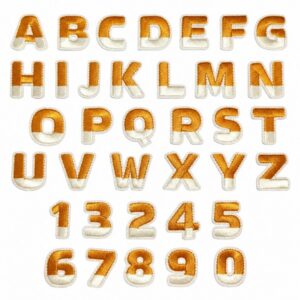
An alphabet patch order needs a character-by-character quantity map, not just a request to match a catalogue picture. List the exact letters or digits, identify the visual reference and ask the supplier to confirm which items it can offer. Reconcile each quantity and approved sample before describing the shipment as an agreed assortment.
Turn the reference picture into an enquiry list
The cached XH Patches home includes an Embroidered patch category with an image of gold-coloured letters and digits. It provides a relevant starting point for an alphabet-patch enquiry. The category image does not confirm that every pictured character is available, that a standard complete set is supplied, or that a buyer can request a new typeface. Treat those as questions for the offered item rather than capabilities already established by the image.
Write the actual character list in text as well as attaching the reference. Keep uppercase letters, lowercase letters and digits separate where your requirement distinguishes them. A request for an assortment should say which characters belong in it and how many of each are required. If your intended mix differs from the catalogue array, identify the difference explicitly and ask whether that mix can be quoted.
Create one row for each distinct item
Use a stable line reference for each character and visual version. If the same character is needed in two proposed sizes or appearances, give those items separate lines instead of relying on a note beside one total. This keeps the quantity requirement connected to the exact item being discussed. Leave supplier availability and item-code fields pending until the supplier identifies its offered references.
Add a column for the purchasing unit. Individual pieces, grouped sets and bags can produce different totals even when the character list looks identical. Ask the supplier to state which unit its quotation uses. If the order is assembled into repeatable kits, describe the contents of one kit and distinguish the number of kits from the number of pieces. Do not infer a standard pack from the arrangement in a category photograph.
Assortment field | Buyer instruction | Confirmation needed
Character | Exact letter or digit and case | Matching offered item reference
Appearance | Named image or approved sample | Actual available version
Quantity | Pieces required for this line | Accepted quantity and quoted unit
Kit allocation | Contents of one requested kit | Whether the requested grouping is offered
Exceptions | Unanswered or substituted lines | Explicit response before approval
Approve legibility and outline as observed features
Ask for a sample or clear offered-item photograph that allows your team to identify the character. Some letters and digits can be confused when a small image is enlarged or viewed out of context. Use the actual sample to distinguish the intended outline and orientation. The selected category picture is a small reference image, so it should not become a precise drawing of thread paths, dimensions or edge construction.
If size matters to the application, mark the measurement points on a separate reference. State whether the requested dimension concerns the full patch outline or another defined span, then ask the supplier to report the offered sample against those points. Keep colour approval tied to a named sample or agreed reference. A gold-coloured appearance on a screen does not verify a metallic material, colourfastness or a matching physical shade.
Keep attachment and rights questions outside the picture
The category label and photograph do not establish the backing or the method for applying the patch. Ask the supplier to identify the reverse side and the proposed attachment process for the exact offered item. Any required garment compatibility or care result needs separate evidence and an agreed review. Do not publish an iron-on instruction or wash-performance claim merely because the item appears in an embroidered-patch category.
If the purchase involves a buyer-provided design, identify who supplies the artwork and what approval is required before use. The general alphabet reference is not evidence of permission for a separate logo or branded design. Keep artwork ownership, production availability and sample approval as distinct questions. Do not assume that accepting a character mix establishes a custom manufacturing service, authorization relationship or finished-product endorsement.
• Use exact character text alongside the visual reference.
• Separate different sizes or appearances into distinct order lines.
• State pieces, kits and packing units without mixing their totals.
• Confirm backing, application and any artwork permissions separately.
Reconcile the mix before the purchase order
Compare the supplier’s response with every line of the character map. Mark unavailable or altered items explicitly instead of allowing them to disappear from the confirmed list. If a proposed substitution changes the mix, issue a revised map and ask the supplier to acknowledge that version. Preserve the earlier record so the purchasing and receiving teams can see which discussion was superseded.
For receiving, use the approved line references and quantity basis to identify what needs checking. Where kits are required, keep the kit-content map beside the order rather than relying on a carton total alone. The objective is to make the intended assortment traceable from enquiry to supply. This improves the clarity of the purchase without inventing stock availability, production terms, material properties or performance claims that the source does not establish.
Frequently asked questions
Does the category array prove a complete alphabet set is supplied?
No. Ask which characters and quantities the supplier can offer, then confirm the exact contents in writing. A display arrangement is not an agreed packing list.
Can a screen image be the final size and colour standard?
Use it to identify the discussion, then agree measurements and a physical or otherwise controlled reference appropriate to the order. Small catalogue images do not establish precise dimensions or material properties.
Should missing characters be replaced automatically?
No. Record the exception and obtain approval for a revised mix. A substitute can change the purpose of a kit even when its total number of pieces remains the same.
Product and contact references
Catalogue reference: confirm matching item: https://xhpatches.com/products/?product_filter=%e5%88%ba%e7%bb%a3%e5%b8%83%e8%b4%b4
Related catalogue reference: https://xhpatches.com/products/
Contact XH Patches: https://xhpatches.com/contact/
XH Patches blog: https://xhpatches.com/blog/